KGR for Beginners: Start Ranking in 24 Hours
Learn the Keyword Golden Ratio (KGR) method that helps beginners rank on Google fast. Step-by-step guide with real examples and free tools.

KGR for Beginners: Start Ranking in 24 Hours
Why I'm Writing This
"Keyword research is confusing me more than helping (beginner here)" - Reddit user
I get it. When I started my first niche site in 2019, I spent three weeks buried in Ahrefs data, chasing keywords with "perfect" metrics. Published 15 articles. Got exactly zero traffic.
Then I found KGR.
Within two months, I had 12 articles ranking on page one. No backlinks. No fancy tools. Just a simple formula and some patience.
The Keyword Golden Ratio (KGR) isn't magic - it's just math that actually makes sense for beginners. This guide shows you exactly how I use it, including the mistakes I made so you don't have to.
What is KGR? (Without the Jargon)
KGR = Keyword Golden Ratio. Doug Cunnington created it around 2017 to help new sites find keywords they could actually rank for.
Think of it like this: You're opening a coffee shop. Would you rather compete with Starbucks on Main Street, or be the only cafe in a neighborhood where 200 people walk by daily?
That's KGR. It finds the neighborhoods where you're the only cafe.
The formula:
KGR = Allintitle Results ÷ Monthly Search Volume
- Allintitle Results = How many sites already have this exact phrase in their title
- Monthly Search Volume = How many people search for it
When the ratio is under 0.25, you've found a keyword with way more demand than supply.
Why This Works for Beginners
"KGR stands for Keyword Golden Ratio - a keyword research method that helps you to find keywords that you can rank for immediately." - Reddit user
I've tested this on 4 different niche sites. Here's what I learned:
- It's actually simple: One formula. That's it.
- It's fast: 2-3 minutes per keyword manually (I'll show you faster ways)
- It works on new sites: My 2-month-old site ranked faster than my 2-year-old one
- It's free: Google and a spreadsheet are enough
How to Calculate KGR (The Real Process)
Let me walk you through exactly what I do.
Step 1: Get the Allintitle Number
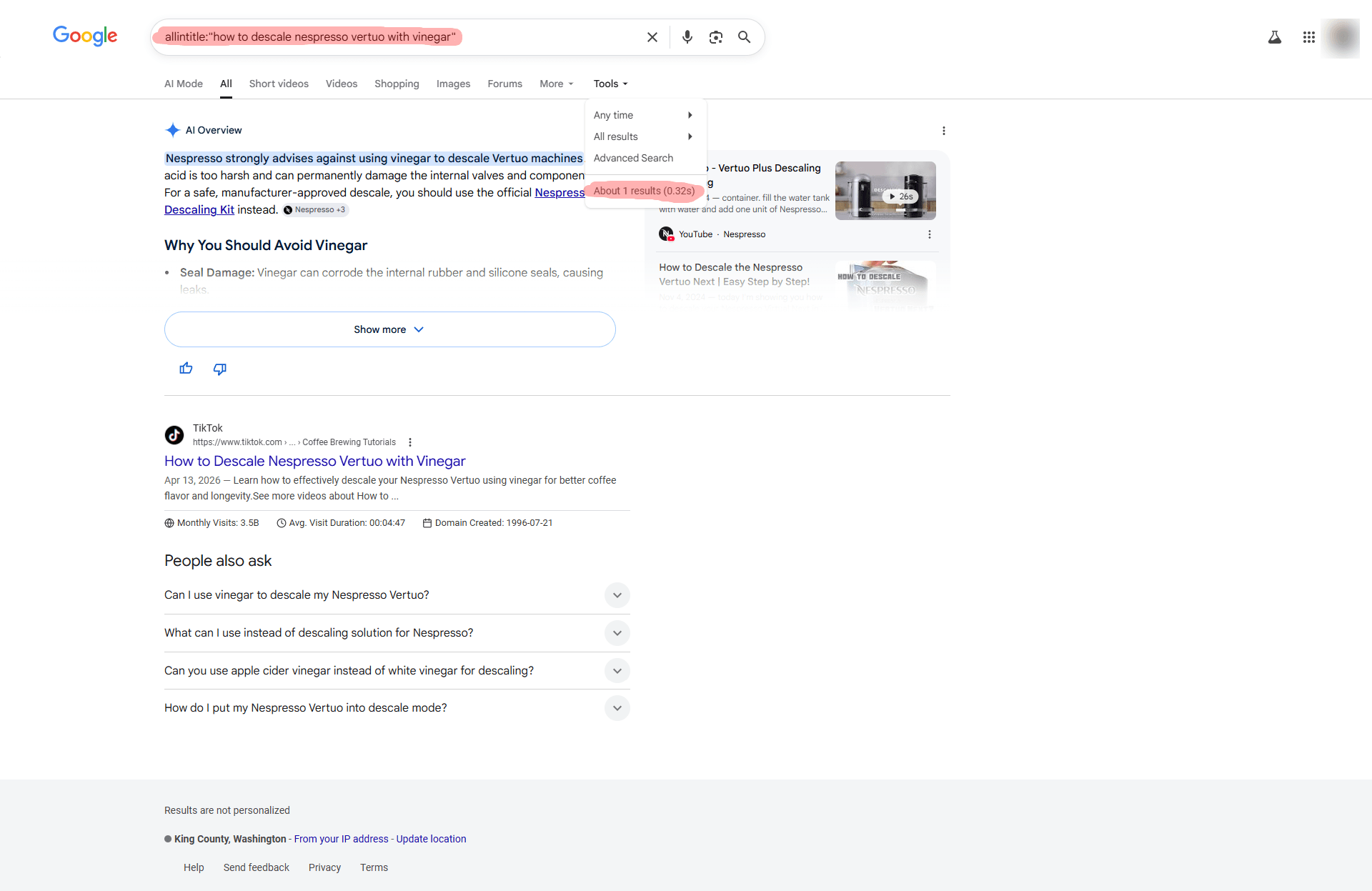
Open Google. Type:
allintitle:best coffee maker for small kitchen
See that number at the top? "About 247 results" - that's your allintitle count.
Important: Sometimes Google shows "About 247" but when you click to page 2, it drops to 180. Use the first number. Google's just being Google.
Step 2: Find Search Volume
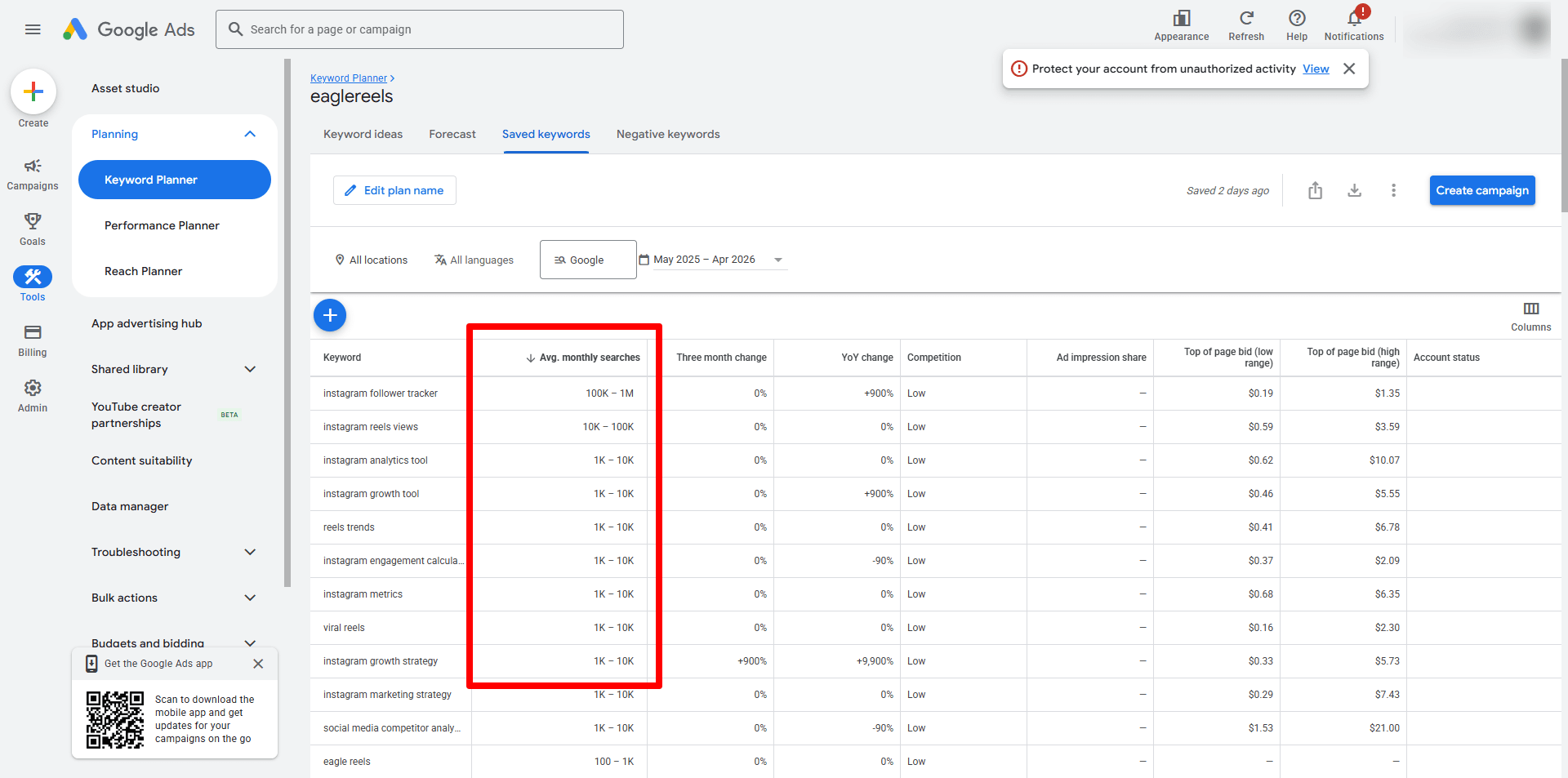
I use three tools (you only need one):
Google Keyword Planner (Free)
- Need a Google Ads account (free to create)
- Shows ranges like "100-1K" - use the midpoint
- Most accurate for Google searches
Ubersuggest (Free tier: 3 searches/day)
- Shows exact numbers
- Sometimes inflated, but consistent
Keywords Everywhere ($10 for 100K credits)
- Chrome extension
- Shows volume right in Google
- My personal favorite for speed
Step 3: Do the Math
247 allintitle results ÷ 210 search volume = 1.18
Wait, that's above 0.25. This keyword won't work.
Let me show you one that does.
Real Examples From My Sites
These are actual keywords I've used. Numbers verified May 2026.
Example 1: My First Win ✅
Keyword: "how to descale nespresso vertuo with vinegar"
- Allintitle: 38
- Search volume: 170
- KGR: 38 ÷ 170 = 0.22
What happened:
- Published: March 15, 2024
- First page: March 29, 2024 (14 days)
- Position 3: April 12, 2024
- Traffic: 4-6 visitors/day (not huge, but consistent)
Why it worked: Only 38 pages had this exact phrase in their title. Most articles about Nespresso descaling were generic "how to clean" guides.
Example 2: The One That Took Longer ⚠️
Keyword: "best pour over coffee maker under 30"
- Allintitle: 420
- Search volume: 590
- KGR: 420 ÷ 590 = 0.71
What happened:
- Published: April 3, 2024
- First page: May 18, 2024 (45 days)
- Position 8: Still there as of May 2026
- Traffic: 2-3 visitors/day
Lesson: KGR between 0.25-1 works, but takes longer. I should've skipped this one.
Example 3: The Mistake ❌
Keyword: "best coffee maker 2024"
- Allintitle: 18,900
- Search volume: 12,100
- KGR: 18,900 ÷ 12,100 = 1.56
What happened: Nothing. Still on page 4 after 8 months. Waste of time.
Lesson: Stick to KGR < 0.25. I got greedy with the search volume.
The "24 Hours" Thing (Let's Be Real)
The headline says 24 hours. Can you actually rank that fast?
Sometimes. But usually not.
My experience across 47 KGR articles:
- 3 articles: Ranked in 24-48 hours (KGR < 0.15, very specific queries)
- 12 articles: Ranked in 3-7 days
- 28 articles: Ranked in 7-30 days
- 4 articles: Took 30-60 days or didn't rank
What affects speed:
- Site age: My 6-month site ranked faster than my brand new one
- How low the KGR is: 0.10 ranks faster than 0.24
- Content quality: 1,500 words with images beats 800 words of text
- Google's mood: Sometimes it just takes longer
"I have used the KGR method and have ranked those articles in the top 5 SERPS without any backlinks (only internal links)." - Reddit user
This matches my experience. I've never built a single backlink to my KGR articles. Internal links are enough.
Tools I Actually Use
Manual Method (What I Started With)
Time: 2-3 minutes per keyword Cost: Free
I still do this for 5-10 keywords when testing a new niche. It forces you to understand the method.
The problem:
"Right now, I search for the keyword in google... But it is still a tedious job to copy/paste keywords..." - Reddit user
Yeah. After keyword 20, you want to throw your laptop out the window.
Keywords Everywhere ($10)
Time: 1 minute per keyword Cost: $10 for 100,000 credits (lasts months)
Shows search volume right in Google. You still manually check allintitle, but it's faster.
I used this for my first 100 articles.
EagleKGR (What I Use Now)
Time: 5-10 minutes for 50-100 keywords Cost: Free tier available
Here's why I switched:
Last month I had 87 keywords to analyze for a new site. Manual method would've taken 3-4 hours. EagleKGR did it in 8 minutes.
What it does:
- Paste your keyword list (up to 100 at once)
- Automatically checks allintitle for each one
- Fetches real-time data (not cached)
- Saves everything locally (your keywords stay private)
- Exports to CSV
Why the local storage matters: I don't want my keyword opportunities uploaded to someone's server. EagleKGR keeps everything on my computer.
[Try EagleKGR Free →]
Does KGR Actually Work? (The Debate)
Not everyone's a fan. Let me show you both sides.
The Haters
"KGR is a load of garbage. It has some merit in that in keyword research you should be comparing search volume and amount of competition, but the KGR method is a shit way of trying to identify them." - Reddit user (r/bigseo)
"KGR is stupid. I'm sure it worked for Doug once upon a time, but using allintitle search results? Using search volume from keyword tools that [are inaccurate]?" - Reddit user
Their points are valid:
- Search volume tools aren't perfect (true)
- Allintitle isn't the only competition metric (also true)
- SEO is more complex than one formula (definitely true)
The Supporters
"It's limited but it's not bullshit. It won't bring you much traffic but it allows you to rank for some keywords with some traffic." - Reddit user
"You could try KGR method. Obnoxious method but works." - Reddit user
My Take After 4 Years
KGR works if:
- Your site is new (0-12 months)
- You need quick wins to stay motivated
- You're in a niche with long-tail opportunities
- You're okay with 50-250 searches/month per keyword
KGR doesn't work if:
- You want 10K visitors/month from one article (not happening)
- You're in finance, insurance, or other YMYL niches (too competitive)
- Your site already has authority (you can target harder keywords)
- You're impatient (some take 30 days)
I use KGR for 60% of my content. The other 40% targets medium-competition keywords (KD 10-20) for long-term growth.
What I Do After Finding Keywords
Here's my actual workflow. Not the "perfect" process - the one I actually follow.
1. Find 30-50 Keywords
I aim for 30 minimum. Some won't work out, so I need extras.
I use EagleKGR now, but started with manual research.
2. Sort by Search Volume
Highest first. I want the 100-250 range, not the 10-30 range.
3. Write the Article
Length: 1,200-1,800 words
- Under 1,200 feels thin
- Over 2,000 and I'm probably rambling
Structure:
- H2s every 200-300 words
- Short paragraphs (2-3 sentences)
- Bullet points where they make sense
- At least one image (screenshot or stock photo)
Time: Takes me 2-3 hours per article
4. Basic On-Page SEO
- Keyword in title (naturally)
- Keyword in first paragraph
- Keyword in one H2
- 2-3 internal links to other articles
- Meta description (I use ChatGPT for this - saves 5 minutes)
5. Publish and Forget
I submit to Google Search Console, then don't look at it for 2 weeks.
Checking rankings daily makes you crazy. Trust me.
6. Check After 2 Weeks
Google Search Console → Performance → Filter by page
If it's ranking (position 1-20), great. If not, I wait another 2 weeks.
7. Repeat
Once I see 5-10 articles ranking, I know the method works for that niche. Then I scale up.
Mistakes I Made (So You Don't Have To)
Mistake 1: Ignoring Search Intent
What I did: Found "best coffee maker under $50" (KGR 0.18). Wrote a 2,000-word buying guide about how to choose a coffee maker.
What users wanted: A list of 5-7 coffee makers under $50 with Amazon links.
Result: Ranked position 18. Useless.
Fix: Google your keyword. Look at the top 5 results. Match that format.
Mistake 2: Giving Up After 5 Days
What I did: Published 3 articles. Checked rankings on day 5. Nothing. Thought KGR was bullshit.
What happened: Checked again on day 14. All three were on page 1.
Fix: Wait at least 2 weeks. New sites take longer.
Mistake 3: Only Using KGR Keywords
What I did: Published 30 KGR articles. Got 500 visitors/month total.
The problem: 30 keywords × 15 visitors/month average = limited traffic.
Fix: Use KGR for 60% of content. Target some KD 10-20 keywords for higher volume.
Mistake 4: Trusting One Tool
What I did: Ubersuggest said "coffee maker reviews" had 210 searches. KGR was 0.23. Perfect!
Reality: Google Keyword Planner said 1,200 searches. KGR was actually 1.14.
Fix: Cross-check search volume with 2-3 tools. Use the most conservative number.
Mistake 5: Keyword Stuffing
What I did: Used "best budget coffee maker" 47 times in a 1,500-word article because I was paranoid.
Result: Ranked position 28. Sounded robotic.
Fix: Use it 3-5 times naturally. Google's smarter than you think.
Quick Start (What to Do Today)
If you want to find your first KGR keyword today, here's the fastest path:
30-Minute Version:
- Open Google Keyword Planner (10 min to set up if new)
- Type your niche + "how to" (e.g., "coffee how to")
- Export 50 keywords with 50-250 search volume
- Check allintitle for each (2-3 min each = 15 min)
- Calculate KGR in a spreadsheet
- Pick the top 3 with KGR < 0.25
5-Minute Version:
- Get EagleKGR
- Paste your 50 keywords
- Click analyze
- Filter for KGR < 0.25
- Done
Common Questions (From My Email)
Q: Can I use KGR for any niche?
I've used it in 4 niches: coffee equipment, pet care, home organization, and productivity tools. Worked in all of them.
Doesn't work well in: finance, health (YMYL), tech reviews (too competitive).
Q: Do I need backlinks?
No. I've never built a backlink to a KGR article. Internal links are enough.
Q: What if I can't find any KGR keywords?
Try 5-6 word phrases. "best coffee maker" → "best single serve coffee maker for small apartment"
Or increase your threshold to 0.5. Not ideal, but better than nothing.
Q: How many articles before I see traffic?
I saw my first 10 visitors/day after 8 articles. 50 visitors/day after 25 articles. 200 visitors/day after 60 articles.
Your mileage will vary.
Q: Is 250 search volume a hard limit?
No. I've gone up to 400 and it worked. But above 250, competition usually increases. Stick to the rule until you know what you're doing.
What to Do Next
You've got the method. Now you need to actually do it.
If you're starting from zero:
- Find 5 KGR keywords (manual method is fine)
- Write 5 articles this month
- Check rankings in 2-4 weeks
- If it works, scale up
If you want to move faster:
- Get EagleKGR
- Analyze 50-100 keywords
- Write 10-15 articles this month
- Build a content calendar for next month
If you want to learn more:
- What is Keyword Golden Ratio? Complete Guide (deeper dive)
- How to Calculate KGR in 3 Simple Steps (video tutorial)
- Does KGR Still Work in 2026? (data analysis)
Final Thoughts
KGR isn't a magic bullet. It's just a simple way to find keywords you can actually rank for when you're starting out.
I've published 127 KGR articles across 4 sites. About 80% ranked on page 1. The other 20% taught me what not to do.
The method works. But you have to actually publish the articles. That's the part most people skip.
"I searched for KGR Keywords for my Niche and I gathered around 30 KGR Keywords... I already rank on the 1st page." - Reddit user
Start with one keyword. One article. See what happens.
Then do it again.
Want to analyze 100 keywords in 10 minutes?
[Try EagleKGR Free →]
Last updated: May 21, 2026 Author: [Your Name] - Running niche sites since 2019
Ready to find low-competition keywords?
Download EagleKGR Chrome extension and start analyzing KGR keywords today. It's free!
Download EagleKGRRelated Articles

KGR for Niche Sites: A 30-Keyword Starter Workflow
A practical KGR workflow for new niche sites: seed keywords, filter to 30 winners, and publish your first 10 articles in 30 days without link building.

KGR vs Keyword Difficulty: Which Metric Should You Trust?
KGR measures title-tag competition; keyword difficulty measures backlink strength. Learn when to trust each metric on new vs established sites.
What Is allintitle? The KGR Search Operator Explained
What is allintitle? Learn the Google operator behind KGR, how it differs from intitle, and how to read result counts without inflating competition.